Description
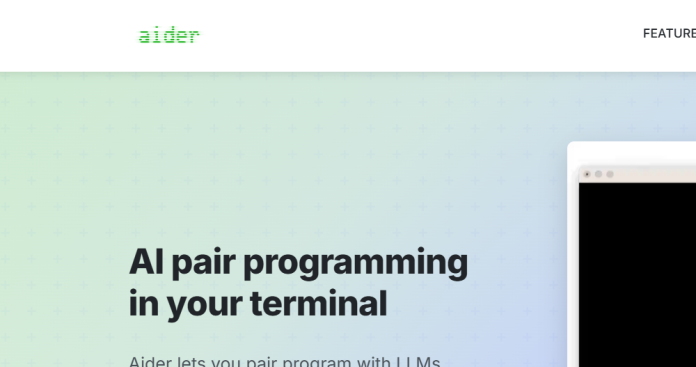
Aider is an open-source, terminal-based AI pair programmer created by Paul Gauthier, released under the Apache 2.0 license. It edits files directly in a local Git repository based on natural language requests, automatically committing each change with a clear commit message so every AI edit stays reviewable and revertible. Aider builds a map of an entire codebase using tree-sitter syntax parsing, surfacing function signatures and class definitions without loading every file into context, which lets it work effectively even on large projects. Its architect mode pairs a strong reasoning model for planning with a faster, cheaper model for making the actual file edits, cutting API costs on complex tasks. Because it’s editor-agnostic, working purely through stdin/stdout against the local filesystem, Aider runs identically in VS Code, JetBrains IDEs, Vim, Emacs, or a bare terminal over SSH. It suits developers who want an AI coding assistant that isn’t tied to a specific editor and who are comfortable working from the command line.
Key Features
- Architect/editor mode — a reasoning model plans the change, a faster editor model writes the actual file edits.
- Repository mapping — tree-sitter-based map of the whole codebase, without loading every file into context.
- Automatic Git commits — every AI change is committed with a descriptive message, kept fully revertible.
- Watch mode with AI! / AI? comments — leave a comment in any file and Aider implements or answers it in the background.
- Lint and test auto-fix loop — runs linters and test suites after each edit and revises until they pass.
- Voice-to-code and /web /paste commands — dictate instructions or paste in reference content mid-session.
- Model-agnostic via LiteLLM — switch between Claude, GPT, DeepSeek, Gemini, Grok, or local Ollama models mid-session with /model.
How It Works
After installing via pip or Homebrew, Aider is pointed at a local Git repository and started from the terminal. A developer adds relevant files to the chat with /add, then describes the change they want in plain language; Aider defaults to code mode, editing files directly, but /architect mode splits the work between a planning model and a separate editor model for harder problems, and /ask mode discusses an approach without making changes yet. Every accepted edit is committed to Git automatically with a clear message. Watch mode runs Aider in the background: leaving a comment like # add input validation. AI! in any source file, then saving it, is enough for Aider to detect the marker, make the change, commit it, and clear the marker, all without leaving the editor. After edits, Aider can automatically run configured linters and test suites, feeding any failures back to the model until they pass or it reports what it couldn’t fix.
Technical Architecture & Overview
- Core Engine: Not one model; connects to any LiteLLM-supported provider, including Claude, GPT, DeepSeek, Gemini, Grok, and local Ollama models, switchable mid-session.
- Deployment: Command-line tool for macOS, Linux, and Windows, installed via pip or Homebrew; works in any terminal or editor without a dedicated plugin.
- API Surface: No hosted API; Aider is a local CLI tool that calls whichever LLM provider’s API the user configures with their own key.
- Known Limits: Requires comfort with a terminal-based workflow; users pay for their own LLM API usage separately, since Aider itself charges nothing.
Pros & Cons
| Pros | Cons |
|---|---|
| Completely free and open source under Apache 2.0, with roughly 44,000 GitHub stars | Terminal-based workflow requires comfort with the command line; not a GUI-first tool |
| Editor-agnostic by design, working the same way in any IDE, terminal, or over SSH | No hosted service; every change relies on the user’s own configured LLM API key and its cost |
| Architect/editor mode cuts API costs on complex tasks by splitting planning from editing | Some LLMs perform noticeably better than others in Aider’s edit format, so model choice affects reliability |
| Automatic Git commits keep every AI change reviewable and easy to revert | No built-in team collaboration features like shared boards or centralized billing |
| Model-agnostic via LiteLLM, so switching providers mid-session needs no restart | Watch mode and voice-to-code require some setup and familiarity to use effectively |
Pricing
| Plan | Price |
|---|---|
| Aider | Free (open source, Apache 2.0; users pay for their own LLM API usage) |
Platform Availability
macOS | Linux | Windows | Any editor (terminal-based)
Best For
Terminal-comfortable developers | Open-source contributors | Multi-language projects | Editor-agnostic workflows
Frequently Asked Questions
Is Aider free to use?
Yes. Aider is free and open source under the Apache 2.0 license; the only cost is usage of whichever LLM API provider a user connects, billed separately by that provider.
What is architect mode in Aider?
Architect mode splits a coding task between two models: a strong reasoning model plans the change, and a faster editor model turns that plan into specific file edits, which can reduce cost on complex tasks.
Does Aider work with any code editor?
Yes. Aider is editor-agnostic, working through the terminal against the local filesystem, so it functions the same way in VS Code, JetBrains IDEs, Vim, Emacs, or a plain terminal without needing a plugin.
What is watch mode in Aider?
Watch mode runs Aider in the background, detecting special AI! or AI? comments left in any source file and implementing or answering them automatically once the file is saved, without switching to the terminal.
Which AI models can Aider use?
Aider connects to any LiteLLM-supported provider, including Claude, GPT, DeepSeek, Gemini, Grok, and local Ollama models, switchable mid-session with the /model command.
Similar Tools in This Directory
Also in AI No-Code Builders: Cody by Sourcegraph, cross-repository AI code context | Sweep, next-edit autocomplete for JetBrains | Vibe Kanban, orchestrate multiple coding agents | Eidolon AI, open-source agent server