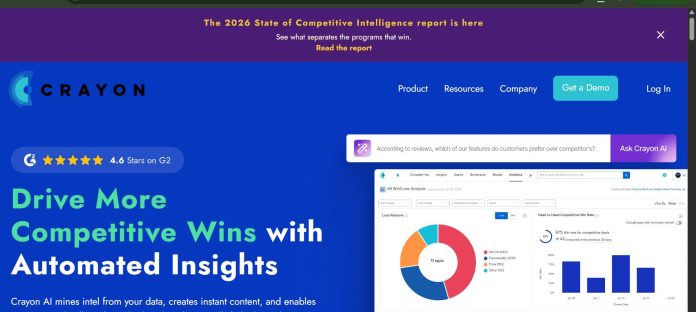
Description
Crayon is an AI-powered competitive intelligence platform that automatically tracks competitor activity across 100+ data types, including website changes, pricing pages, product launches, job postings, news coverage, SEC filings, patents, and social media, then turns that raw signal into structured, actionable outputs like AI-generated battlecards. It’s used by hundreds of companies including Gong, TriNet, and DocuSign, and integrates directly into the tools sales and product marketing teams already work in: Salesforce, HubSpot, Slack, Microsoft Teams, and sales enablement platforms like Highspot and Seismic. Crayon is positioned as an enterprise-grade competitive intelligence platform, with pricing to match.
Key Features
- Automated competitor tracking: Monitors 100+ data types including website changes, pricing, job postings, patents, and news.
- AI-generated battlecards: Sparks feature turns raw competitive signal into structured, sales-ready battlecards automatically.
- Conversation intelligence integration: Detects competitor mentions in Gong and Chorus sales calls and embeds call snippets into battlecards.
- CRM and enablement integrations: Bidirectional sync with Salesforce, HubSpot, and FreshSales; delivery into Highspot, Seismic, Guru, and more.
- Win-loss data ingestion: Pulls in structured win-loss interview data via Clozd integration.
- MCP server: An official Model Context Protocol server for AI agent connectivity, added in 2025.
How It Works
Crayon’s AI continuously monitors more than 100 data types across a company’s defined set of competitors, watching for website and pricing page changes, new product launches, job postings, news coverage, and even patent filings, aggregating all of it into a centralized Compete Hub accessible to the whole organization. Its Sparks feature uses AI to organize and analyze this incoming data automatically, generating structured battlecards that sales reps can pull up directly inside Salesforce or Slack during a live deal, rather than digging through a static document. Conversation intelligence integrations with Gong and Chorus detect when a competitor comes up in a sales call and automatically embed that snippet into the relevant battlecard, closing the loop between what’s happening in the market and what reps hear from prospects. Despite the automation, most Crayon deployments still require a dedicated competitive intelligence owner to curate alerts, filter noise, and distribute insights effectively.
Technical Architecture & Overview
- Core Engine: AI-powered competitive agents (Sparks) that continuously monitor, organize, and analyze signal across 100+ data types.
- Deployment: Cloud-based Compete Hub dashboard, with an official MCP server for AI agent integration added in 2025.
- API Surface: Deep integrations with Salesforce, HubSpot, FreshSales, Slack, Microsoft Teams, Gong, Chorus, and major sales enablement platforms; no native Zapier or Make connection and no self-serve webhook endpoint.
- Known Limits: Crayon does not publish pricing; third-party procurement data estimates typical deployments at $20,000-$50,000+/year, requiring 2-4 weeks of setup plus a dedicated CI analyst spending 5-10 hours/week managing the platform. Not designed for startups or teams without a dedicated CI budget owner.
Pros & Cons
| Pros | Cons |
|---|---|
| Monitors 100+ data types, among the broadest automated coverage in the category. | No public pricing; third-party estimates put typical deployments at $20,000-$50,000+/year, out of reach for smaller teams. |
| Sparks AI turns raw signal into structured battlecards automatically rather than requiring manual drafting. | Setup takes 2-4 weeks and most deployments need a dedicated CI analyst spending 5-10 hours/week. |
| Deep, bidirectional integrations with Salesforce, HubSpot, Gong, and Chorus embed intelligence where reps work. | No native Zapier or Make connection, and no self-serve webhook endpoint for custom automations. |
| An official MCP server, added in 2025, makes it AI-agent-ready ahead of many competitors. | Automated monitoring still requires human interpretation; a pricing change alone doesn’t explain what it means strategically. |
Our Take
Crayon is best suited for mid-market and enterprise product marketing or competitive intelligence teams that already have, or plan to hire, someone to own the platform full-time. The automation itself is genuinely strong: monitoring 100+ data types and generating battlecards automatically is real leverage. But at an estimated $20,000-$50,000+/year with a 2-4 week setup, that leverage only pays off with a dedicated owner curating and distributing what the platform surfaces.
Not ideal for: startups or lean teams without a dedicated CI budget line and headcount — a lighter-weight competitor-tracking tool, or simply a manual process, is likely to deliver more value per dollar at that stage.
This assessment is based on Crayon’s documented feature set, pricing structure, and third-party procurement data; we have not run a paid Crayon deployment ourselves.
Pricing
| Plan | Price |
|---|---|
| Essentials / Professional / Enterprise | Custom, sales-led (no published rate) |
Crayon’s official pricing page does not publish rates — every plan is quote-based. The $20,000-$50,000+/year range referenced on this page is a third-party procurement estimate (Vendr and similar sources), not a figure Crayon publishes itself.
Last verified: August 17, 2026
Platform Availability
Web
Best For
Mid-market and enterprise product marketing teams needing systematic competitor tracking | Sales teams wanting AI-generated battlecards delivered directly in Salesforce and Slack
Similar Tools in This Directory
Direct alternative: Klue, a competitive enablement platform in the same price range, built more tightly around sales enablement and native win-loss analysis.
Related tools also in AI Marketing Tools: Similarweb, digital intelligence and traffic analytics | Brandwatch, enterprise social listening and consumer intelligence | Talkwalker, AI social listening and consumer intelligence | SparkToro, audience research tool | SurveyMonkey, AI survey and market research platform | Perplexity AI, AI answer engine with research tiers | Google Trends, free search interest and trend research
Visit Official Website
Frequently Asked Questions
How much does Crayon cost?
Crayon does not publish pricing; typical annual contracts are estimated at $20,000-$50,000 or more depending on the number of competitors tracked, seats, and integrations, according to third-party procurement data, not Crayon’s own site.
What is Crayon’s Sparks feature?
Sparks is Crayon’s AI feature that automatically organizes and analyzes incoming competitive data, generating structured battlecards without requiring manual drafting.
Does Crayon integrate with Gong and Chorus?
Yes, conversation intelligence integrations with Gong and Chorus automatically detect competitor mentions in sales calls and embed call snippets directly into battlecards.
Does Crayon require a dedicated team member to manage it?
Most Crayon customers employ at least one dedicated competitive intelligence analyst to curate alerts, filter noise, and distribute insights; the platform automates collection but still requires human interpretation.
Does Crayon have an MCP server?
Yes, Crayon added an official MCP (Model Context Protocol) server in 2025 for AI agent integration.
Is Crayon a good fit for startups?
Not usually. Crayon’s pricing and setup are built for mid-market and enterprise teams with a dedicated competitive intelligence owner; startups and lean teams are typically better served by a lighter-weight, self-serve competitor-tracking tool.
How does Crayon compare to Klue?
Both are enterprise competitive intelligence platforms in a similar price range. Klue is built more tightly around sales enablement and native win-loss analysis, while Crayon’s strength is breadth of automated data monitoring and its Sparks AI battlecard generation.