If you’ve asked a developer forum which AI coding tool is “best” lately, you’ve probably gotten five different answers and at least one argument about what “best” even means. That’s fair. An agentic coding assistant that reads your codebase, plans a fix, edits across files, and runs your tests is a different animal from an autocomplete plugin, and this list only covers that first kind: tools that act, not just suggest. No-code app builders aren’t in scope here either.
The picks below lean on published benchmarks like SWE-bench Verified and Terminal-Bench, official pricing pages, and developer sentiment from places like Reddit and dev blogs, all dated where it matters. What they don’t include is a hands-on test where I ran the same coding task across all five tools myself and scored the output side by side. That’s a real gap, and a meaningfully weaker form of evidence than actually watching a tool work. I’ll flag it wherever a score depends on that missing test rather than pretend the benchmark numbers settle it.
One more thing worth saying upfront: this article covers Claude Code, a product made by Anthropic, the company behind the model writing this article. That’s a real conflict of interest. I’m not going to pretend it isn’t, and if you’re the type of reader who wants a second opinion on that specific entry before trusting it, that instinct is a good one.
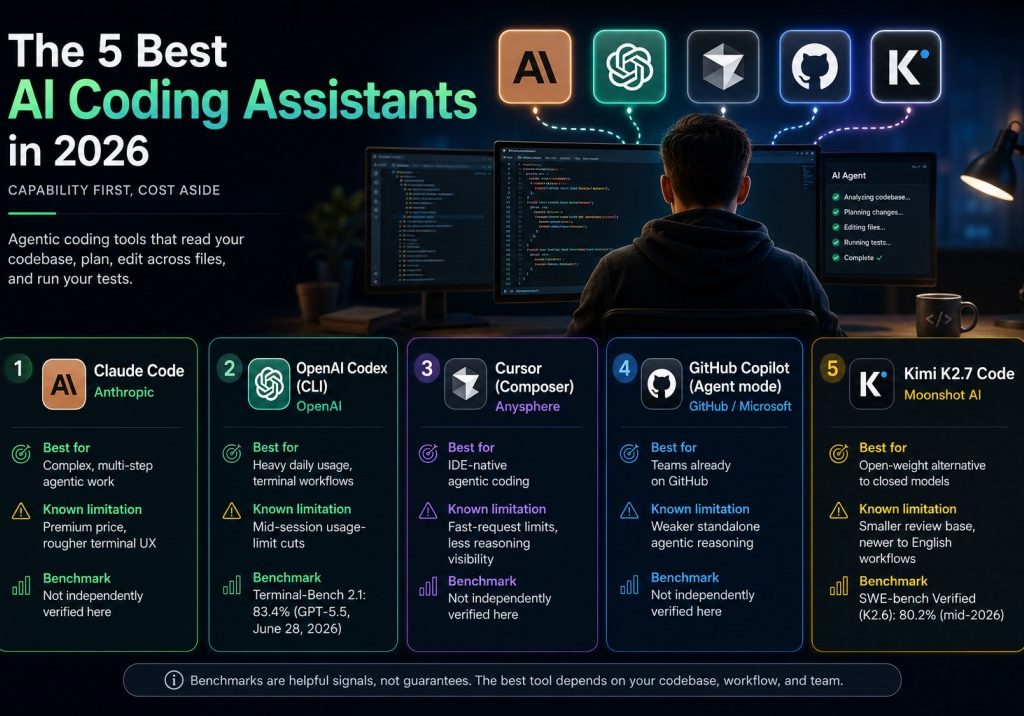
1. Claude Code (Anthropic)
Claude Code showed up at the top of a late-July 2026 roundup for complex, multi-step agentic work and large-codebase understanding, and one feature that keeps coming up in comparisons is per-subagent model control, letting you assign different models to different parts of a task instead of running everything through one. The tradeoff is price: it sits at a premium relative to open-weight alternatives, and its terminal interface has been described as rougher around the edges than GUI-wrapped competitors like T3 Code.
I don’t have an independently run benchmark score to hand you here, and given who made this article, I’d treat that gap as more important than usual. If Claude Code is a serious option for your team, it’s worth getting a second source to confirm the multi-step-work reputation before you commit.
2. OpenAI Codex (CLI)
Codex has the most concrete adoption numbers on this list: one June 2026 report puts it at more than 5 million weekly users, with over 85% of OpenAI’s own staff reportedly using it internally. On the benchmark side, it currently sits at #1 on the public Terminal-Bench 2.1 leaderboard at 83.4%, running on GPT-5.5, as of a tracker dated June 28, 2026.
The complaint that shows up most often on r/codex isn’t quality, it’s usage limits. Developers report mid-stream cuts that hit harder in practice than the sticker price would suggest, which matters if your workflow involves long agentic sessions rather than short bursts.
3. Cursor (Composer agent)
Cursor is the tool other developers measure everything else against, more often than any other name on this list. Its in-house Composer 2.5 model shipped May 18, 2026, and the IDE-native experience is the main draw if you want an agent living inside your editor instead of a separate terminal window.
The friction point is “fast request” limits, which can bite on heavy-usage days, and Cursor gives you less visibility into the agent’s reasoning process than a CLI-based tool would. If you’re the kind of developer who wants to see the chain of decisions before trusting an edit, that’s worth weighing.
4. GitHub Copilot (Agent mode)
Copilot’s strongest case is for teams already living inside GitHub. A July 2026 pricing update added live flex billing and a $100 Max tier, which suggests GitHub is pushing it further into serious agentic territory rather than leaving it as an autocomplete tool.
Comparative reviews consistently describe its standalone agentic reasoning as weaker than Claude Code’s or Codex’s. That doesn’t make it a bad choice, it makes it a workflow-fit choice: if your team’s whole process already runs through GitHub issues, PRs, and Actions, the integration might matter more than a few points of raw capability.
5. Kimi K2.7 Code (Moonshot AI)
This is the one open-weight model that keeps showing up in independent 2026 comparisons as matching or beating Claude Code on SWE-bench. Its predecessor, K2.6, scored 80.2% on SWE-bench Verified with automatic context caching, a source dated mid-2026.
Two honest caveats: it’s newer to English-first developer workflows than the others on this list, and its third-party review base is thinner than the closed-source leaders. A strong benchmark number and a proven track record in daily use aren’t the same thing, and Kimi K2.7 Code has more of the former than the latter right now.
The comparison table
| Tool | Maker | Best for | Known limitation | Benchmark |
|---|---|---|---|---|
| Claude Code | Anthropic | Complex, multi-step agentic work | Premium price, rougher terminal UX | Not independently verified here |
| OpenAI Codex (CLI) | OpenAI | Heavy daily usage, terminal workflows | Mid-session usage-limit cuts | Terminal-Bench 2.1: 83.4% (GPT-5.5, June 28, 2026) |
| Cursor (Composer) | Anysphere | IDE-native agentic coding | Fast-request limits, less reasoning visibility | Not independently verified here |
| GitHub Copilot (Agent mode) | GitHub/Microsoft | Teams already on GitHub | Weaker standalone agentic reasoning | Not independently verified here |
| Kimi K2.7 Code | Moonshot AI | Open-weight alternative to closed models | Smaller review base, newer to English workflows | SWE-bench Verified (K2.6): 80.2% (mid-2026) |
A few that almost made the cut
Devin is more autonomous than anything on this list, but it comes at a higher price point that puts it out of reach for a lot of teams. OpenCode is the most-starred open-source harness on GitHub, north of 180,000 stars, but it’s a harness, not a model. That distinction matters: OpenCode’s actual output quality depends entirely on which model you plug into it, so it can’t really compete head-to-head with a tool that ships its own model. Windsurf rebranded to Devin Desktop, Google’s Antigravity 2.0 is worth a look only if you’re fully committed to GCP and Firebase, and Grok Build is rising fast but too new for anyone to confidently rank yet.
What would make this list more trustworthy
Right now, this ranking leans on borrowed benchmark numbers and secondhand sentiment, not a test I ran myself. A genuinely reliable version of this article would run the same fixed coding task, say, a defined multi-file bug fix plus a defined new-feature build on the same test repo, across all five tools and score the actual output on a consistent rubric. Until that happens, treat the SWE-bench and Terminal-Bench figures above as supporting evidence pointing in a direction, not as proof of which tool will work best on your codebase. The gap between “scored well on a public benchmark” and “will handle your specific mess of legacy code and half-written tests” is real, and no benchmark closes it for you.