Every “best cheap AI coding tool” list runs into the same problem: cheap and bad is easy to find, and cheap and good is the thing people actually want. So the bar for this list isn’t the lowest sticker price on the market. It’s the lowest realistic API cost per unit of coding capability, and every entry here has an independently cited benchmark score behind it, not just a low number on a pricing page.
The same caveat from the capability-first list applies here, maybe more so. The benchmark scores below come from published sources like SWE-bench Verified, official pricing pages, and pricing-tracker sites, dated where I could pin them down, not from a fixed coding task I ran across all five tools myself. That’s a real limitation. In one case below, two different trackers report meaningfully different scores for the same model, and I’m not going to average them together and pretend that solves the problem. I’ll tell you exactly where that happened.
1. DeepSeek V4-Flash
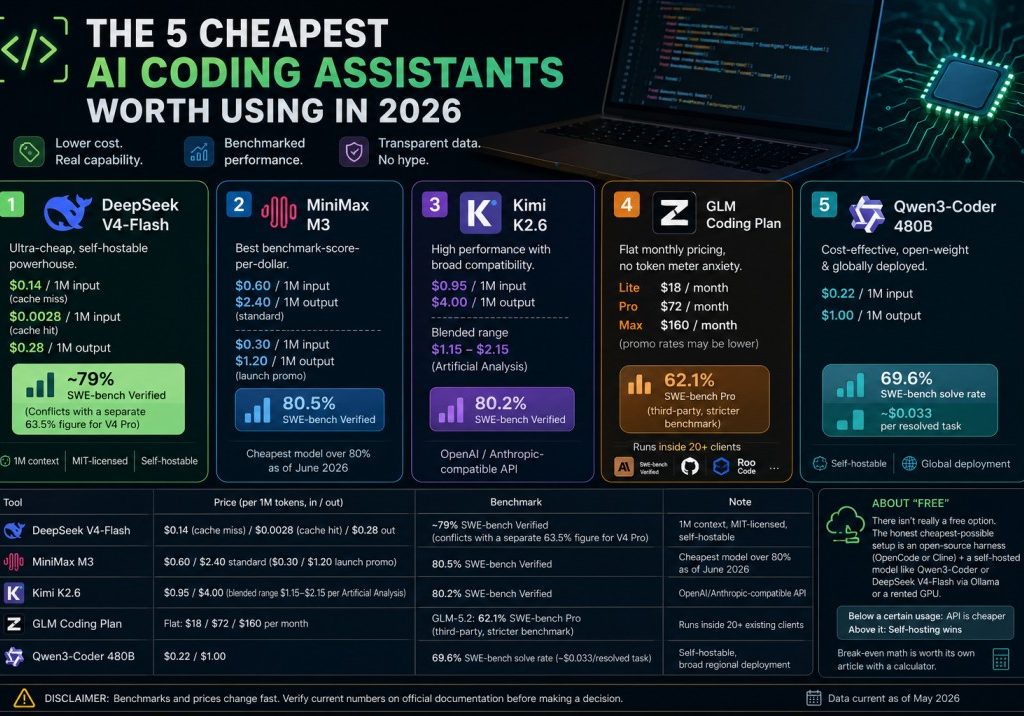
DeepSeek V4-Flash prices at $0.14 per million input tokens on a cache miss, drops to $0.0028 on a cache hit, and $0.28 per million output tokens. It’s MIT-licensed, self-hostable, and runs a 1M-token context window, which is a genuinely rare combination at this price point.
Here’s the part I want to be straight with you about: one source cites roughly 79% on SWE-bench Verified for V4-Flash, while a separate source puts DeepSeek V4 Pro, a different model in the same family, meaningfully lower at 63.5%. Those numbers aren’t measuring the same thing, and different trackers disagree even within the same family. If DeepSeek V4-Flash is a real contender for your team, verify the specific number directly against DeepSeek’s own documentation before you build a decision around it. I’m flagging this instead of picking whichever number sounds better, because that’s the whole point of a trustworthy list.
2. MiniMax M3
MiniMax M3 runs $0.60 per million input tokens and $2.40 per million output tokens at standard pricing, with a launch promo cutting that to $0.30 and $1.20. At 80.5% on SWE-bench Verified, one June 2026 tracker cites it as the cheapest model scoring above 80% on that benchmark, which is a meaningful claim if it holds up: that’s roughly the same territory as some of the closed-source leaders, at a fraction of the cost.
The obvious question with any “cheapest model above X score” claim is how long the pricing holds. Launch promos end. If you’re evaluating this for a long-running project, check the standard rate, not just the promo rate, before you commit.
3. Kimi K2.6
Kimi K2.6 lists at $0.95 per million input tokens and $4.00 output, though Artificial Analysis reports a blended multi-provider range of $1.15 to $2.15, depending on which provider is actually serving the request. It scored 80.2% on SWE-bench Verified and includes automatic context caching, which helps offset the per-token cost on repeated work over the same codebase.
The practical advantage here is compatibility: Kimi K2.6 uses an OpenAI- and Anthropic-compatible API, so it drops into harnesses you might already have set up without a rebuild. That’s a real cost saving that doesn’t show up in a per-token price comparison.
4. GLM Coding Plan
This is the odd one out on this list, and deliberately so. Instead of metered tokens, Z.ai’s GLM Coding Plan runs flat monthly tiers: Lite at $18, Pro at $72, Max at $160, with promo rates sometimes running lower. There was no official SWE-bench figure at launch, and the closest third-party number available, from llm-stats, puts GLM-5.2 at 62.1% on SWE-bench Pro, a different and stricter benchmark than SWE-bench Verified, so it isn’t a clean apples-to-apples comparison with the other entries here.
What makes it worth including anyway is the flat bill. If your team’s biggest complaint about AI coding tools isn’t quality, it’s the anxiety of watching a metered bill climb during a long debugging session, a fixed monthly cost solves a real problem that a lower per-token price doesn’t. It also runs inside more than 20 existing clients, including Claude Code, Cline, and Roo Code, so switching to it doesn’t mean switching your whole workflow.
5. Qwen3-Coder 480B
Qwen3-Coder prices at $0.22 input and $1.00 output per million tokens, with a 69.6% SWE-bench solve rate. One cost-per-task analysis puts that at roughly $0.033 per resolved task, which is the kind of number that actually means something if you’re trying to estimate a monthly budget rather than just compare sticker prices.
It’s open-weight, self-hostable, and deployed broadly enough, Singapore, the US, the EU, that regional latency and data-residency concerns are less of a blocker than they are with some of the other options here.
The comparison table
| Tool | Price (per 1M tokens, in/out) | Benchmark | Note |
|---|---|---|---|
| DeepSeek V4-Flash | $0.14 (cache miss) / $0.0028 (cache hit) / $0.28 out | ~79% SWE-bench Verified (conflicts with a separate 63.5% figure for V4 Pro) | 1M context, MIT-licensed, self-hostable |
| MiniMax M3 | $0.60 / $2.40 standard ($0.30 / $1.20 launch promo) | 80.5% SWE-bench Verified | Cheapest model over 80% as of June 2026 |
| Kimi K2.6 | $0.95 / $4.00 (blended range $1.15–$2.15 per Artificial Analysis) | 80.2% SWE-bench Verified | OpenAI/Anthropic-compatible API |
| GLM Coding Plan | Flat: $18 / $72 / $160 per month | GLM-5.2: 62.1% SWE-bench Pro (third-party, stricter benchmark) | Runs inside 20+ existing clients |
| Qwen3-Coder 480B | $0.22 / $1.00 | 69.6% SWE-bench solve rate (~$0.033/resolved task) | Self-hostable, broad regional deployment |
About “free”
There isn’t really a free option here, and I’d rather say that plainly than pad the list with something that technically costs $0 and quietly disappoints you. The honest cheapest-possible setup is an open-source harness like OpenCode or Cline, paired with a self-hosted open-weight model such as Qwen3-Coder or DeepSeek V4-Flash, run through Ollama or a rented GPU. That trades a per-token bill for a fixed compute cost, and whether that’s actually cheaper depends entirely on how much you use it. Below a certain usage volume, you’re paying more for the GPU rental than you would for API calls. Above it, self-hosting wins. If enough people ask, that break-even math is worth its own article with an actual calculator, rather than a paragraph of hand-waving here.
The short answer
For the best benchmark-score-per-dollar right now, look at DeepSeek V4-Flash and MiniMax M3. If you’d rather pay a flat monthly bill than track metered tokens, the GLM Coding Plan is the one to check first, and it has the advantage of running inside tools you might already use, like Claude Code, Cline, or Roo Code.
Where this list is weaker than it should be
Two things would make this genuinely trustworthy instead of a well-sourced first draft. First, the DeepSeek benchmark conflict needs to be resolved against DeepSeek’s own documentation, not left as a range. Second, every number above comes from someone else’s test, not one run on a fixed task set across all five tools with a named tester and a test date. Until that happens, use this list to narrow your options, not to make a final call without checking the current price and benchmark pages yourself. Prices and promo rates in this category move fast enough that “current as of publication” has a short shelf life.