Description
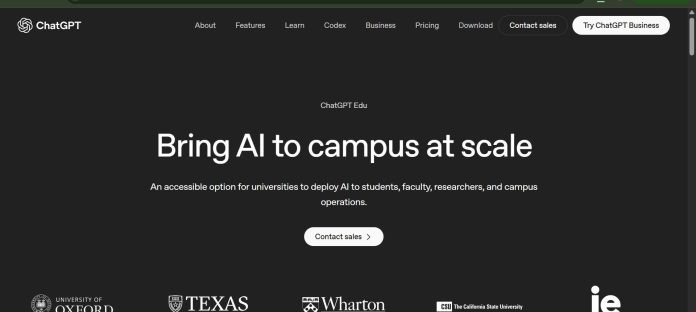
ChatGPT Edu is OpenAI’s institution-purchased plan for universities, giving eligible students, faculty, and staff free access to premium ChatGPT features through their school account. Universities including Oxford, Wharton, UT Austin, and Columbia have deployed it campus-wide, with enterprise-level security and no training on institutional data.
Key Features
- Higher message limits: Substantially more usage than free ChatGPT.
- Advanced tools: Data analysis, web browsing, and file uploads included.
- Custom GPTs: Build and share course-specific versions within the university workspace.
- 50+ languages: Improved language quality and speed across languages.
- Enterprise-level security: SSO, SCIM, group permissions, and admin controls.
- No model training: Institutional conversations are never used to train OpenAI’s models.
How It Works
A university purchases and deploys ChatGPT Edu campus-wide, and eligible students, faculty, staff, and postdocs sign in with their school account to get free Standard-tier access — the same models and features as the $20/month Enterprise plan, at no individual cost. Instructors can build custom GPTs scoped to a specific course and share them only within the university workspace, while IT departments manage access and security centrally.
Technical Architecture & Overview
- Core Engine: OpenAI’s flagship GPT models, with the same underlying model access as ChatGPT Enterprise.
- Deployment: Web, iOS, Android, and desktop, provisioned through university single sign-on.
- API Surface: Flexible/credit-based pricing applies to Business, Enterprise, and Edu usage beyond included limits.
- Known Limits: Only available where a university has purchased and deployed it; individual students at non-participating schools cannot buy Edu access themselves.
Pros & Cons
| Pros | Cons |
|---|---|
| Free to the eligible student — the university pays, not the individual. | Only available if your university has purchased and deployed it. |
| Same model access and features as the $20/month Enterprise plan. | Students at non-participating schools get no discount — same consumer pricing as everyone else. |
| Enterprise-level security and no training on institutional conversations. | Doesn’t include a distinct guided-tutoring mode — that’s Study Mode, a separate ChatGPT feature. |
| Custom GPTs let instructors build course-specific tools without a developer. | Institutional pricing isn’t public; universities negotiate directly with OpenAI. |
Pricing
| Plan | Price |
|---|---|
| Eligible students, faculty, staff at participating universities | Free |
| Individual ChatGPT Plus (non-participating schools) | $20/month |
Platform Availability
Web | iOS | Android | Desktop
Best For
University students, faculty, and staff whose school has deployed ChatGPT Edu campus-wide | IT departments wanting centrally managed AI access with enterprise security
Similar Tools in This Directory
Also worth comparing: Claude for Education, free university access with a Learning Mode tutor | Gemini for Education, free Workspace-based AI for schools | NotebookLM, source-grounded AI research and study tool | Gradescope, AI-assisted grading at scale
Visit Official Website
Frequently Asked Questions
Is ChatGPT Edu free for students?
Yes, for eligible students, faculty, and staff at a university that has purchased and deployed it — the institution pays, not the individual.
What’s the difference between ChatGPT Edu and ChatGPT Plus?
Edu is purchased by a university for its whole community and matches Enterprise-level features; Plus is an individual $20/month consumer subscription.
Which universities use ChatGPT Edu?
Announced partners include Oxford, Wharton School, UT Austin, Arizona State University, and Columbia, among others.
Is ChatGPT Edu secure for institutional use?
Yes, it includes SSO, SCIM, group permissions, and a commitment that conversations aren’t used to train OpenAI’s models.
Can I sign up for ChatGPT Edu myself as a student?
No. It has to be purchased and deployed by your university; individual students cannot buy Edu access directly.