Description
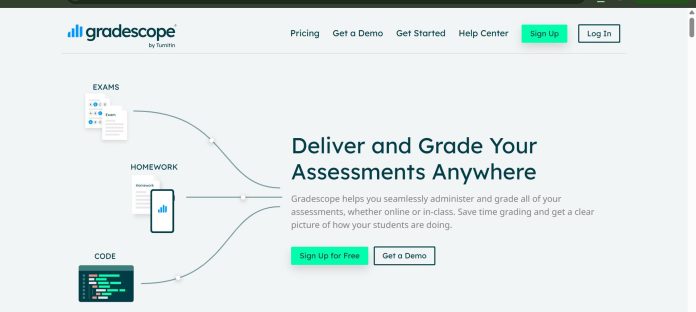
Gradescope is Turnitin’s AI-assisted grading platform, used at more than 2,600 universities including Harvard, Stanford, and MIT. It groups similar student answers together so an instructor grades once per group instead of once per student, working across handwritten exams, bubble sheets, and programming assignments.
Key Features
- AI answer grouping: Clusters similar responses so instructors grade a group at once.
- Dynamic rubrics: Retroactively update every graded submission when a rubric item changes.
- Handwriting and math OCR: Recognizes handwritten exams and equations, including fill-in-the-blank math.
- Autograders for code: Instructor-defined autograders score programming assignments automatically.
- LMS integration: Syncs grades with Canvas, Blackboard, Moodle, and Brightspace.
- Turnitin integration: Institutional plans can layer in Turnitin’s AI and originality detection.
How It Works
An instructor uploads exams, assignments, or code submissions — scanned, digital, or synced from an LMS — and Gradescope’s AI groups similar answers together. The instructor builds a rubric once and applies it to an entire group of matching answers in a single pass, rather than regrading the same answer repeatedly, while dynamic rubrics let a point change retroactively update every submission that used it.
Technical Architecture & Overview
- Core Engine: OCR and answer-similarity grouping for handwritten and digital submissions, paired with instructor-defined autograders for code.
- Deployment: Web-based, integrated with Canvas, Blackboard, Moodle, Brightspace, and code repositories like GitHub.
- API Surface: None public — end-user grading platform.
- Known Limits: Institutional licensing (AI-assisted grading, collaborative grading, SSO) is contact-sales only, with no public per-seat price.
Pros & Cons
| Pros | Cons |
|---|---|
| Free Basic plan covers core grading workflows, not just a trial. | AI-assisted grading and collaborative grading require an institutional license with no public price. |
| Answer grouping genuinely cuts repetitive grading work at scale. | Gradescope itself doesn’t detect AI-generated writing — that requires connecting Turnitin separately. |
| Used at 2,600+ universities, including Harvard, Stanford, MIT, and UC Berkeley. | Best suited to large courses; setup overhead is less worth it for a small class. |
| Handles handwritten exams, bubble sheets, and code in one platform. | Free Basic plan doesn’t include LMS sync or SSO — those are institutional-tier features. |
Platform Availability
Web | Canvas, Blackboard, Moodle, Brightspace (integrations)
Best For
Instructors grading large courses who want AI to group similar answers instead of grading each submission individually
Similar Tools in This Directory
Also worth comparing: Claude for Education, free university access with a Learning Mode tutor | ChatGPT Edu, free campus-wide access for universities | Gemini for Education, free Workspace-based AI for schools | NotebookLM, source-grounded AI research and study tool
Visit Official Website
Frequently Asked Questions
Is Gradescope free?
Yes, the Basic plan covers core grading workflows for free; AI-assisted and collaborative grading require an institutional license.
Does Gradescope detect AI-written student work?
Not on its own — that requires connecting Turnitin’s separate AI detection feature.
Can Gradescope grade handwritten exams?
Yes, its OCR recognizes handwritten answers and math equations, including fill-in-the-blank problems.
Does Gradescope work with programming assignments?
Yes, instructors can build autograders that score code automatically, with GitHub and Bitbucket integration.
Which universities use Gradescope?
More than 2,600, including Harvard, Stanford, MIT, UC Berkeley, and Carnegie Mellon.