Description
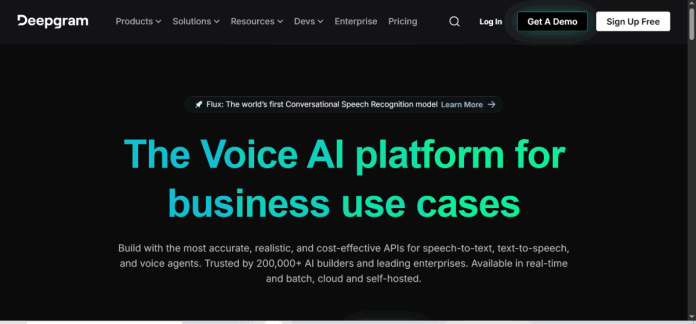
Deepgram is a developer-first voice AI platform built around three core APIs: Speech-to-Text, Text-to-Speech, and Voice Agent, unified into a single API rather than requiring separate components stitched together. Its Flux model handles real-time conversational transcription with built-in turn detection and language auto-detection, while Nova-3 handles general-purpose speech-to-text across pre-recorded and streaming audio. The platform supports 45-plus languages, multi-speaker diarization, and both cloud and self-hosted deployment, serving use cases from call center analytics and healthcare transcription to live captioning and voice agents.
Key Features
- Flux — a conversational speech-to-text model with sub-300ms latency, built-in turn detection, and automatic language identification.
- Nova-3 — Deepgram’s general-purpose speech-to-text model for pre-recorded and streaming audio.
- Aura-2 text-to-speech — generates natural-sounding speech from text with low latency.
- Unified Voice Agent API — chains speech-to-text, an LLM, and text-to-speech into one API instead of three separately billed services.
- Audio Intelligence — summarization, topic detection, intent recognition, and sentiment analysis over audio or text.
- Self-hosted deployment — cloud, on-premises, or VPC deployment for teams with compliance or data-residency needs.
How It Works
A developer sends audio, either a pre-recorded file or a live stream, to Deepgram’s Speech-to-Text API and picks a model: Nova-3 for general transcription, or Flux for real-time conversational use where turn detection matters. The same account also exposes a Text-to-Speech API for generating natural-sounding audio from text, and a Voice Agent API that chains speech-to-text, an LLM, and text-to-speech together so a developer doesn’t have to stitch three separate services together. Vocabulary prompts and keyterm tuning let a model adapt to domain-specific terms without full retraining. All APIs run over REST and WebSocket, with official SDKs for Python, JavaScript, .NET, Go, and Java, and can run on Deepgram’s cloud or be self-hosted for stricter compliance needs.
Technical Architecture & Overview
- Core Engine: Deepgram’s proprietary Flux and Nova-3 speech-to-text models, plus its Aura-2 text-to-speech model.
- Deployment: Cloud API (REST and WebSocket) or self-hosted (on-premises/VPC); SDKs for Python, JavaScript, .NET, Go, and Java.
- API Surface: Separate Speech-to-Text, Text-to-Speech, Voice Agent, and Audio Intelligence APIs under one account and billing pool.
- Known Limits: Self-hosted deployment and custom endpoints are positioned toward Growth/Enterprise customers rather than entry-level Pay As You Go.
Pros & Cons
| Pros | Cons |
|---|---|
| No minimums, no expiration, and no credit card required to start on Pay As You Go. | Growth-tier pricing starts at $4,000 a year, a steep jump from Pay As You Go. |
| Flux’s sub-300ms latency and built-in turn detection suit real-time voice agents. | Enterprise pricing isn’t published and requires contacting sales. |
| The Voice Agent API bundles speech-to-text, an LLM, and text-to-speech into one API instead of three. | Self-hosted deployment is aimed at larger customers rather than solo developers. |
| Self-hosted deployment is available for teams that can’t send audio to a third-party cloud. | Some advanced features sit behind the Growth or Enterprise tiers. |
| Official SDKs cover Python, JavaScript, .NET, Go, and Java. | The free $200 credit eventually runs out on usage-heavy projects, moving billing to metered pay-as-you-go. |
Pricing
| Plan | Price |
|---|---|
| Pay As You Go | Free $200 credit, then pay-as-you-go |
| Growth | $4K+/year (prepaid credits) |
Platform Availability
Cloud API | Self-Hosted
Best For
Developers and startups building voice features with no upfront commitment | Growing applications wanting prepaid annual credits at a discount | Enterprises needing self-hosted deployment and custom compliance
Similar Tools in This Directory
Also worth comparing: Speechify AI, a text-to-speech and voice agent API with a shared usage balance | ElevenLabs, a voice generator known for realism and a separate developer API | Play.ht, a flat-rate text-to-speech platform with a large multilingual voice library | Murf AI, a studio-focused voice generator with Canva and PowerPoint integrations | LOVO AI, a text-to-speech and video platform built around the Genny studio | Voicemod, a real-time voice changer for gaming and streaming rather than pre-recorded voiceovers
Visit Official Website
Frequently Asked Questions
Does Deepgram have a free plan?
Yes. Deepgram’s Pay As You Go tier includes a $200 free credit with no minimums, no expiration, and no credit card required, according to Deepgram’s official pricing page.
How much does Deepgram cost?
Pay As You Go starts with a $200 free credit and then bills metered usage, while Growth starts at $4,000+ a year in prepaid credits at a discount, according to Deepgram’s official pricing page.
What is Deepgram Flux?
Flux is Deepgram’s conversational speech-to-text model, built for real-time use with sub-300ms latency and automatic turn detection, according to Deepgram’s official documentation.
Does Deepgram offer a Voice Agent API?
Yes. Deepgram’s Voice Agent API chains speech-to-text, an LLM, and text-to-speech into a single API, according to Deepgram’s official site.
Can Deepgram be self-hosted?
Yes. Deepgram supports self-hosted deployment on-premises or in a VPC alongside its standard cloud API, according to Deepgram’s official documentation.