Description
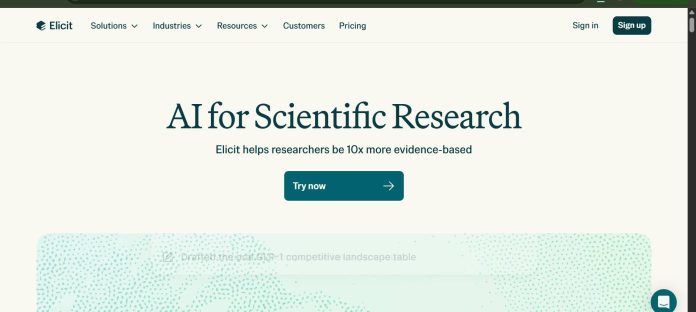
Elicit is an AI research assistant built around literature review workflows — finding relevant papers, extracting structured data, and comparing studies across more than 138 million papers and 545,000 clinical trials. Every AI-generated claim in an Elicit report links to a sentence-level citation, so a researcher can verify it rather than take it on faith.
Key Features
- Semantic paper search: Finds relevant studies across 138M+ papers and 545K+ clinical trials.
- Evidence tables: Extracts structured data (methods, samples, outcomes) across multiple papers at once.
- Systematic Review workflow: Screens up to 5,000 papers with PRISMA 2020-aligned reporting.
- Sentence-level citations: Every AI-generated claim links to its exact source.
- Zotero integration: Import papers directly from an existing reference library.
- Unlimited free searches: Core literature search is unlimited on the free plan.
How It Works
A researcher enters a research question, and Elicit searches its academic database using semantic matching rather than exact keywords, surfacing papers likely to answer the question even if they don’t use the same terminology. From there, Elicit can extract specific data points — sample size, method, outcome — into a shared table across dozens of papers at once, or run a full Systematic Review workflow that screens thousands of papers against inclusion criteria and produces a PRISMA-aligned report.
Technical Architecture & Overview
- Core Engine: Semantic search over an academic paper index, paired with an extraction model that pulls structured data from paper text and cites its source sentence.
- Deployment: Web app.
- API Surface: Available on paid plans for programmatic access.
- Known Limits: AI extraction can miss nuance or misread a paper, so Elicit recommends source-checking; the Systematic Review workflow requires a paid plan.
Pros & Cons
| Pros | Cons |
|---|---|
| Unlimited literature search on the free plan, not just a limited trial. | The free plan’s report length and extraction depth are limited compared to paid tiers. |
| Sentence-level citations make every AI claim checkable against the original text. | Systematic Review and larger extraction tables require a Plus or Pro subscription. |
| Systematic Review workflow supports PRISMA 2020 reporting standards. | AI-extracted data still needs a researcher’s own verification against the source. |
| Zotero integration fits into an existing reference-management workflow. | Coverage is strongest in well-represented fields; niche areas may return fewer results. |
Platform Availability
Web
Best For
Researchers and graduate students doing literature reviews who need structured, citation-backed data extraction across many papers
Similar Tools in This Directory
Also worth comparing: Consensus, evidence-backed academic search engine | Semantic Scholar, free academic search and citation graph | ResearchRabbit, visual citation-network discovery | Paperguide, all-in-one literature review and writing workspace
Visit Official Website
Frequently Asked Questions
Is Elicit free?
Yes, unlimited literature search is available on the free plan; paid plans add more extraction, longer reports, and the Systematic Review workflow.
Does Elicit cite its sources?
Yes, every AI-generated claim in an Elicit report includes a sentence-level citation back to the source paper.
Can Elicit run a full systematic review?
Yes, its Systematic Review workflow can screen up to 5,000 papers with PRISMA 2020-aligned reporting.
How many papers does Elicit search?
Over 138 million academic papers and 545,000 clinical trials.
Does Elicit integrate with Zotero?
Yes, papers can be imported directly from an existing Zotero library.