Description
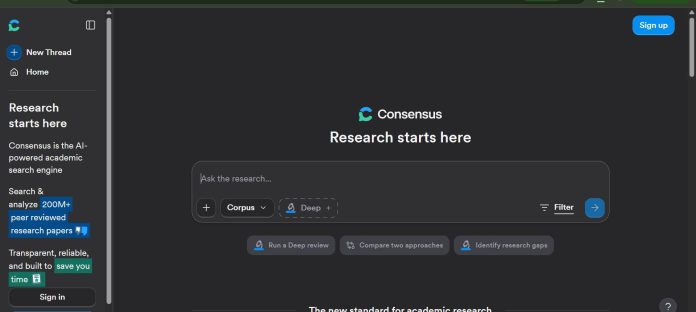
Consensus is an AI-powered academic search engine that reads peer-reviewed papers and answers a research question with evidence-backed citations, rather than links to sift through. Its Consensus Meter shows at a glance how many studies agree, disagree, or are mixed on a yes/no question, drawing from more than 200 million papers.
Key Features
- Consensus Meter: Visualizes how much of the literature agrees, disagrees, or is mixed on a yes/no question.
- Deep Search: Automates a fuller literature review, expanding key terms and mapping arguments.
- Study Snapshots: Quick, structured summaries of an individual paper’s methodology and findings.
- Medical Mode: Narrows results to high-quality clinical and medical sources.
- 200M+ paper database: Aggregated from Semantic Scholar, OpenAlex, and Consensus’s own crawl.
- Chat with a paper: Ask follow-up questions about a specific paper’s findings.
How It Works
A researcher types a question, ideally phrased as yes/no, and Consensus searches its database of peer-reviewed papers, returning the Consensus Meter’s breakdown of how the literature answers it alongside a written synthesis with citations. For a deeper pass, Deep Search expands the search terms, explores the citation graph, and produces a fuller report with a results timeline, top authors, and identified research gaps.
Technical Architecture & Overview
- Core Engine: Large language models applied to a peer-reviewed paper index, with the Consensus Meter built to classify yes/no findings across studies.
- Deployment: Web app.
- API Surface: None public — end-user research tool.
- Known Limits: No deep-linking into a PDF’s exact passage — a researcher still needs to open the source paper to verify context in full.
Pros & Cons
| Pros | Cons |
|---|---|
| The Consensus Meter gives a fast read on where the evidence actually stands. | No deep-linking means a researcher still has to open each cited PDF for exact context. |
| Free tier includes a meaningful number of Pro Searches and Deep Search uses per month. | The interface can lag on more demanding searches, per user reports. |
| Medical Mode is a genuine differentiator for clinical and health-related questions. | Best suited to yes/no or evidence-strength questions, less so open-ended exploration. |
| Every synthesized answer includes citations back to the source papers. | Deep Search’s more advanced report generation is capped even on paid tiers. |
Pricing
| Plan | Price |
|---|---|
| Free | $0 |
| Pro | $15/month or $120/year |
| Deep | $65/month or $540/year |
Platform Availability
Web
Best For
Researchers who want a fast read on what peer-reviewed evidence says about a specific yes/no question
Similar Tools in This Directory
Also worth comparing: Elicit, AI literature review with sentence-level citations | Semantic Scholar, free academic search and citation graph | ResearchRabbit, visual citation-network discovery | Paperguide, all-in-one literature review and writing workspace
Visit Official Website
Frequently Asked Questions
Is Consensus free?
Yes, the free tier includes a limited number of AI-powered searches and Deep Search uses per month.
What is the Consensus Meter?
A visual breakdown showing what percentage of relevant studies answer a yes/no question with yes, no, possibly, or mixed results.
How many papers does Consensus search?
Over 200 million peer-reviewed papers, aggregated from Semantic Scholar, OpenAlex, and its own crawl.
Is Consensus useful for medical research?
Yes, its Medical Mode narrows results to high-quality clinical guidelines and top medical journals.
Does Consensus cite its sources?
Yes, every synthesized answer includes citations back to the specific papers it drew from.