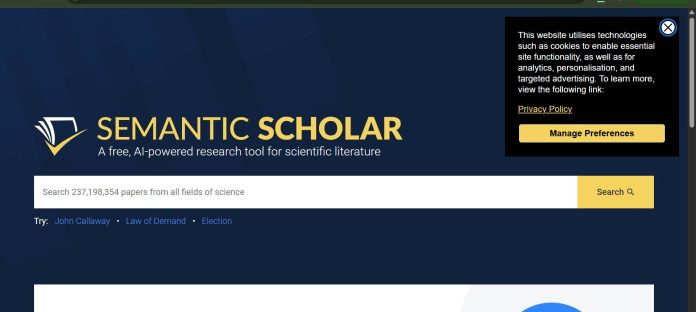
Description
Semantic Scholar is a free academic search engine built by the nonprofit Allen Institute for AI, indexing more than 214 million papers with no feature gating behind a paywall. Its AI-generated TLDR summaries and citation-graph tools help a researcher evaluate dozens of papers’ relevance without reading each one in full first.
Key Features
- TLDR summaries: One-sentence AI summary of a paper’s core contribution.
- Highly Influential Citations: Distinguishes citations that meaningfully shaped a paper from incidental mentions.
- Semantic Reader: An augmented PDF viewer with inline citation cards.
- Research Feeds: Personalized paper recommendations based on saved interests.
- Free public API: Programmatic access to the citation graph, no key required for basic use.
- 214M+ papers: Coverage across all scientific disciplines.
How It Works
A researcher searches a topic or paper title, and Semantic Scholar’s AI ranks results by relevance and influence rather than keyword frequency alone. Opening a paper in Semantic Reader shows inline citation cards for every reference, and Highly Influential Citations flags which of those references actually shaped the paper’s argument, helping a researcher trace a field’s real intellectual lineage rather than every passing mention.
Technical Architecture & Overview
- Core Engine: Semantic search and citation-graph analysis over a 214M+ paper index, with SPECTER2 embeddings available via API.
- Deployment: Web app and a free public REST API.
- API Surface: Free, no key required for light use; a free API key raises rate limits for heavier use.
- Known Limits: Unauthenticated API requests are rate-limited to 100 requests per 5 minutes.
Pros & Cons
| Pros | Cons |
|---|---|
| Completely free with no feature gating — every tool, including the API, is free. | No AI-generated literature reviews or evidence synthesis the way Elicit or Consensus offer. |
| Built and maintained by a nonprofit (Allen Institute for AI), not a venture-backed startup. | Unauthenticated API access is rate-limited; heavier use requires requesting a free key. |
| TLDR summaries and Highly Influential Citations genuinely speed up relevance screening. | TLDR summaries, while useful, can’t replace reading a paper’s full methodology. |
| Free public API makes it usable for developers building their own research tools. | Doesn’t extract structured data across multiple papers the way Elicit does. |
Platform Availability
Web | API
Best For
Researchers and developers who want a free, comprehensive academic search engine and citation-graph API
Similar Tools in This Directory
Also worth comparing: Elicit, AI literature review with sentence-level citations | Consensus, evidence-backed academic search engine | ResearchRabbit, visual citation-network discovery | Paperguide, all-in-one literature review and writing workspace
Visit Official Website
Frequently Asked Questions
Is Semantic Scholar completely free?
Yes, every feature including the API is free, with no paid tier.
What is a TLDR summary?
A one-sentence, AI-generated summary of a paper’s core contribution.
Does Semantic Scholar have an API?
Yes, a free public REST API is available, with higher rate limits for users with a free API key.
Who built Semantic Scholar?
The Allen Institute for AI (AI2), a nonprofit research institute.
How many papers does Semantic Scholar index?
More than 214 million papers across all scientific disciplines.