Description
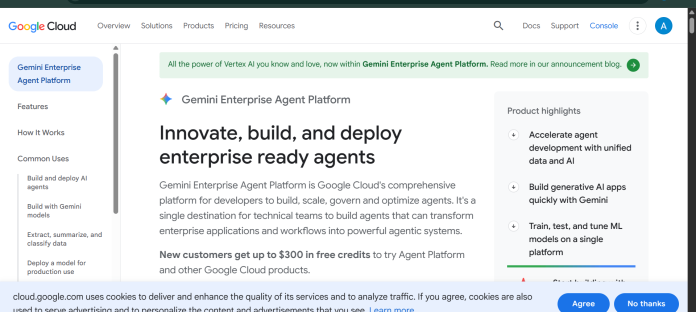
Gemini Enterprise Agent Platform, renamed from Vertex AI, is Google Cloud’s platform for building, scaling, governing, and optimizing AI agents and machine learning models. It combines Agent Studio for designing and tuning generative AI applications with Gemini and other models, Model Garden for browsing more than 200 Google and third-party models including Anthropic’s Claude family and open models like Gemma, and MLOps tools such as Pipelines, Model Registry, and Feature Store for managing the ML lifecycle. Google Antigravity, newly available through the platform, lets teams orchestrate multiple agents to execute multi-step workflows. New customers get $300 in free credits to try the platform, and usage beyond that is billed per Google Cloud resource consumed, primarily model tokens, Agent Storage, and Agent Compute. Data scientists, ML engineers, and developers building agentic applications on Google Cloud make up the core audience, since the platform integrates directly with BigQuery, Compute Engine, and Cloud Storage.
Key Features
- Agent Studio — design, test, and manage prompts for Gemini models using natural language, code, images, or video.
- Model Garden — browse and deploy 200+ Google and third-party models, including Claude and Gemma.
- Google Antigravity — orchestrate multiple agents to execute multi-step workflows like product launches.
- Gemini Enterprise app — securely register, manage, and govern custom-built agents.
- Model Evaluation — compare generative AI model outputs with data-driven assessment tools.
- MLOps tools — automate and manage ML projects with Pipelines, Model Registry, and Feature Store.
- Agent Development Kit (ADK) — build, customize, and fine-tune sophisticated agents with a dedicated framework.
How It Works
Agent Platform provides several paths for building and deploying AI. Agent Studio gives access to large generative AI models, including the Gemini 3 family, for evaluating, tuning, and deploying them inside an application. Model Garden lets developers discover, test, customize, and deploy open-source and third-party models directly in the platform. Custom training gives full control over the training process, including choice of ML framework and hyperparameter tuning. Once a model is ready, it can be registered in Model Registry and served through the prediction service for batch or online use. Notebooks, available as Colab Enterprise or Workbench, integrate natively with BigQuery for a single surface across data and AI workloads. Google Antigravity adds a centralized app for steering and orchestrating multiple agents across a workflow.
Technical Architecture & Overview
- Core Engine: Not one proprietary model. Hosts Google’s Gemini 3 family alongside 200+ third-party and open models, including Anthropic’s Claude family and Gemma, through Model Garden.
- Deployment: Cloud-hosted on Google Cloud; notebooks run through Colab Enterprise or Workbench with native BigQuery integration; agents can be built with the Agent Development Kit (ADK).
- API Surface: Gemini API in Agent Platform, with SDKs and code samples for Python, JavaScript, Java, Go, and cURL, documented on Google Cloud’s developer site.
- Known Limits: Custom model training pricing depends on machine type, region, and accelerators used, and is not listed as a flat rate. Memory Bank and Sessions billing take effect September 1, 2026, and Semantic Governance Policy billing takes effect August 1, 2026, per Google’s own pricing page.
Pros & Cons
| Pros | Cons |
|---|---|
| Access to 200+ Google and third-party models, including Claude and Gemma, through Model Garden | No flat subscription price; billing spans model tokens, agent storage, compute, and management fees separately |
| $300 in free credits for new customers to try the platform | Custom model training cost requires a sales estimate or pricing calculator rather than a published flat rate |
| Built-in MLOps tools: Pipelines, Model Registry, Feature Store, and Model Evaluation | Renamed from Vertex AI, and easily confused with the separate per-seat “Gemini Enterprise” packaged product |
| Google Antigravity adds multi-agent orchestration for complex, multi-step workflows | Several billing components (Memory Bank, Sessions, Semantic Governance Policy) are still rolling out through August and September 2026 |
| Native integration with BigQuery, Compute Engine, and Cloud Storage | Some features, like Antigravity, are newly added and still expanding in scope |
Pricing
| Item | Price |
|---|---|
| Platform access | $0 to start; $300 in free credits for new customers, then pay-as-you-go |
| Model usage (text, chat, code, image generation) | Token-based pricing, varies by model |
| Agent Storage | $0.30/GiB-month |
https://cloud.google.com/products/gemini-enterprise-agent-platform/pricing
Platform Availability
Web (Google Cloud Console) | API | Antigravity desktop app / CLI
Best For
Enterprises on Google Cloud | Data scientists | ML engineers | Developers | Agent orchestration teams
Frequently Asked Questions
Is Vertex AI still called Vertex AI?
No. Google renamed Vertex AI to Gemini Enterprise Agent Platform. The product’s own page states that all the power of Vertex AI is now available within Gemini Enterprise Agent Platform.
How much do new customers get in free credits?
New customers receive up to $300 in free credits to try Gemini Enterprise Agent Platform and other Google Cloud products, per Google’s official pricing page.
What models are available through Model Garden?
Model Garden includes more than 200 Google and third-party models, such as Google’s Gemini 3 family, Anthropic’s Claude model family, and open models like Gemma.
How does Gemini Enterprise Agent Platform differ from Microsoft Foundry?
Both host models from multiple providers and offer agent-building tools with usage-based pricing. Gemini Enterprise Agent Platform centers on Agent Studio and Model Garden inside Google Cloud, while Microsoft Foundry organizes the same idea through Foundry Models and Agent Service inside Azure.
What is Google Antigravity?
Google Antigravity is a centralized app, now available through Agent Platform, that lets teams steer, customize, and orchestrate multiple agents to execute entire workflows such as product launches.
Similar Tools in This Directory
Also in this category: Microsoft Foundry, multi-provider model console on Azure | Amazon Bedrock, multi-provider model console on AWS