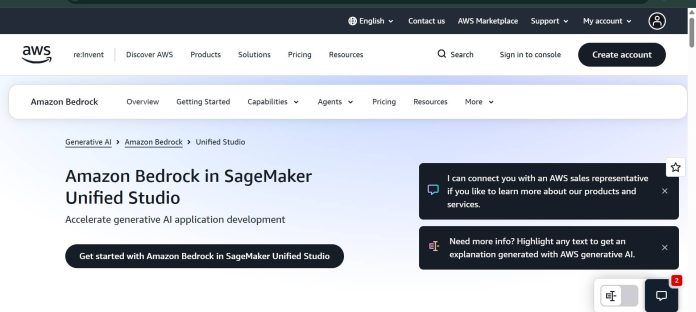
Description
Amazon Bedrock in SageMaker Unified Studio is a browser based interface from AWS that lets developers and business teams build generative AI applications using Amazon Bedrock foundation models without managing separate infrastructure. It sits inside SageMaker Unified Studio, AWS’s combined workspace for data, analytics, and AI projects, and gives access to models from providers including Anthropic, Meta, Amazon, Google, Mistral AI, Cohere, DeepSeek, and OpenAI through a shared model catalog. Users can test prompts in a chat or image and video playground, build no-code chat agent apps or multi-step flow apps, and attach Bedrock features like Knowledge Bases for retrieval augmented generation, Guardrails for content safety, and Functions for tool calling. Teams share and evaluate apps inside the same project workspace. It suits organizations already on AWS that want a governed, collaborative environment for prototyping and deploying generative AI without switching between separate consoles for data and models.
Key Features
- Model catalog — browse and compare Bedrock foundation models from multiple AI providers in one place.
- Chat playground — test prompts and generate text responses from a selected model without code.
- Image and video playground — generate and edit images and video from text or image prompts.
- No-code chat agent apps — build conversational apps backed by a Bedrock model and shared components.
- Flow apps — chain prompts, models, and components such as knowledge bases into multi-step workflows.
- Knowledge Bases and Guardrails — add retrieval augmented generation and content safety filters to an app.
- Model evaluation — compare model outputs across task types before choosing one for an app.
How It Works
Access requires membership in an organization’s SageMaker Unified Studio domain, set up by an administrator through AWS IAM Identity Center. Inside a project, users open the model catalog to review available Bedrock models and their supported modalities. The chat playground sends text or image prompts to a selected model and returns responses inline, while the image and video playground handles visual generation and editing. Building an app means choosing between a chat agent app, for conversational use cases, or a flow app, which links prompts, models, and components such as knowledge bases or guardrails into a workflow. Finished apps live in the project’s asset gallery, where they can be shared with teammates or exported for use outside SageMaker Unified Studio.
Technical Architecture & Overview
- Core Engine: Not a single proprietary model. Access spans foundation models from Anthropic, Meta, Amazon, Google, Mistral AI, Cohere, DeepSeek, OpenAI, Qwen, and others through the Bedrock model catalog.
- Deployment: Browser-based, accessed through the AWS Management Console. Requires an IAM Identity Center based SageMaker Unified Studio domain. No desktop or mobile app.
- API Surface: REST APIs and SDKs documented at docs.aws.amazon.com/bedrock, including InvokeModel and Converse APIs; rate limits and quotas vary per model, account, and AWS Region.
- Known Limits: Context window and knowledge cutoff vary by underlying model since Bedrock hosts many providers’ models rather than one architecture; each model’s limits are documented individually in the model catalog.
Pros & Cons
| Pros | Cons |
|---|---|
| Access to models from many providers, including Anthropic, Meta, Amazon, Google, Mistral AI, and OpenAI, in one console | No flat subscription plan; billing spans dozens of models, regions, and feature types |
| No-code chat agent and flow app builders for non-developers | No desktop or mobile app; browser-based AWS Management Console only |
| Built-in Guardrails, Knowledge Bases, and model evaluation tools | Requires an IAM Identity Center based domain set up by an administrator before use |
| SageMaker Unified Studio interface itself carries no direct charge | Context window and knowledge cutoff vary per underlying model rather than one documented figure |
| Batch inference available at roughly 50 percent lower cost than on-demand for supported models | Provisioned Throughput and custom model hosting require per-model-unit hourly commitments |
Pricing
| Item | Price |
|---|---|
| SageMaker Unified Studio interface | $0 (no direct charge; you pay only for AWS services used through it) |
| Bedrock on-demand model inference | Varies by model, billed per input/output token |
| Bedrock Guardrails | $0.15 per 1,000 text units for content filters and denied topics |
Platform Availability
Web (AWS Management Console) | API / SDK
Best For
Enterprises on AWS | Data teams | ML engineers | Application developers | Regulated industries
Frequently Asked Questions
Is there a separate charge for SageMaker Unified Studio?
No. Per AWS’s SageMaker pricing page, the Unified Studio interface itself carries no direct cost, and core setup, project management, and user management are provided free. You pay for the underlying AWS services and Bedrock model usage.
Which foundation model providers are available through Bedrock in Unified Studio?
The Bedrock model catalog includes models from Anthropic, Meta, Amazon, Google, Mistral AI, Cohere, DeepSeek, OpenAI, Qwen, and several others, with an organization’s administrator controlling which models each user can access.
What is the difference between a chat agent app and a flow app?
A chat agent app provides one conversational interface backed by a single Bedrock model. A flow app chains multiple prompts, models, and components such as knowledge bases into a multi-step workflow, per AWS documentation.
How does Amazon Bedrock in SageMaker Unified Studio compare to Google Vertex AI Model Garden?
Both give access to foundation models from multiple providers in one console. Bedrock in Unified Studio adds no-code chat agent and flow app builders inside a shared project workspace, while Vertex AI’s Model Garden centers on model discovery, tuning, and deployment within Google Cloud.
Does batch inference cost less than on-demand pricing?
Yes. AWS states that select foundation models from Anthropic, Meta, Mistral AI, and Amazon are available for batch inference at roughly 50 percent lower cost than on-demand pricing for the same models.
Similar Tools in This Directory
Also in this category: Microsoft Foundry (Azure AI), Microsoft’s multi-model enterprise AI platform | Gemini Enterprise Agent Platform, Google’s agent-building platform for business