Description
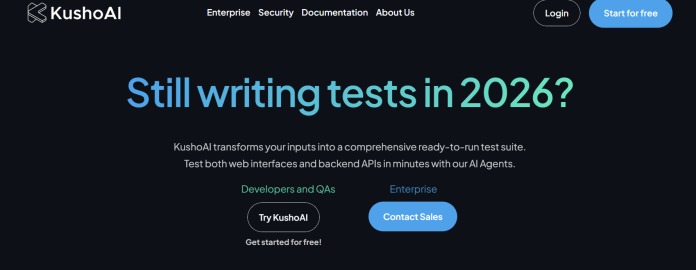
KushoAI is a generative AI quality engineering platform that automates API contract testing, continuous security scanning, and end-to-end workflow validation across a codebase. It generates test suites directly from OpenAPI specs, Postman collections, cURL commands, or recorded UI interactions, and maintains a self-healing test infrastructure that adapts automatically as the underlying application changes. Beyond generating tests, KushoAI computes AI-driven risk scores for a given release, helping engineering leaders decide whether a build is safe to ship. The platform validates complete workflows across services, databases, and UI layers rather than testing components in isolation, and integrates with CI/CD platforms including GitHub Actions, GitLab, Bitbucket, and Jenkins. The Developer Edition is free and covers up to 50 API endpoints, letting a team validate the platform before scaling up. It suits engineering and QA teams that want to shift from manually maintained test suites toward continuously adapting, AI-generated test coverage.
Key Features
- AI-generated test suites — builds tests from OpenAPI specs, Postman collections, cURL commands, or UI recordings.
- Self-healing tests — test infrastructure adapts automatically as the application evolves.
- End-to-end workflow validation — tests complete user journeys across services, databases, and UI layers.
- Continuous security scanning — scans live APIs for security risks alongside functional testing.
- AI-computed risk scores — flags whether a release is safe to ship based on automated risk analysis.
- Natural language test authoring — describe a test scenario in plain language rather than writing test code by hand.
- CI/CD integrations — connects to GitHub Actions, GitLab, Bitbucket, and Jenkins.
How It Works
Teams typically connect a repository, feed KushoAI an API specification, Postman collection, or a recording of a UI interaction, and let it generate an initial set of test cases covering core functionality, edge cases, and complex workflows. On the free Developer Edition, this covers up to 50 API endpoints, enough to validate the platform with a real team before committing further. From there, KushoAI’s self-healing infrastructure keeps monitoring the codebase and automatically updates affected tests as the application changes, rather than requiring a developer to manually patch broken test scripts. Alongside functional testing, the platform runs continuous security scans on live APIs and computes a risk score for each release, giving engineering leads a single signal for go or no-go ship decisions rather than a raw pass/fail test report. Enterprise deployments remove the endpoint cap entirely for unlimited API coverage at scale.
Technical Architecture & Overview
- Core Engine: Generative AI models applied to API specifications and UI interaction data; no single named model documented publicly.
- Deployment: Cloud-based web platform integrated into existing CI/CD pipelines rather than a standalone desktop tool.
- API Surface: Accepts OpenAPI specs, Postman collections, and cURL commands as input; integrates with GitHub Actions, GitLab, Bitbucket, and Jenkins for pipeline automation.
- Known Limits: Developer Edition is capped at up to 50 API endpoints, per KushoAI’s official pricing page; unlimited endpoint coverage requires the custom-quoted Enterprise tier.
Pros & Cons
| Pros | Cons |
|---|---|
| Developer Edition is genuinely free, confirmed directly at $0/month on KushoAI’s own pricing page | Developer Edition caps out at 50 API endpoints, which larger codebases will outgrow quickly |
| Covers functional testing, security scanning, and release risk scoring in one platform rather than three separate tools | Enterprise is the only path past the Developer Edition’s cap, with no published mid-tier plan |
| Self-healing tests reduce the ongoing maintenance burden of keeping test suites current | Enterprise pricing is fully custom, with no published starting figure |
| Generates tests from multiple input formats (OpenAPI, Postman, cURL, UI recordings) | No public API documented for KushoAI itself, only integrations into existing CI/CD tools |
| Validates full workflows across services, databases, and UI layers, not isolated components | Initial setup requires connecting repos and CI/CD pipelines before value is realized |
Pricing
| Plan | Price |
|---|---|
| Developer Edition | $0/month (up to 50 API endpoints; for team validation) |
| Enterprise | Custom pricing (unlimited API endpoints; for deploying at scale) |
Platform Availability
Web | CI/CD integrations (GitHub Actions, GitLab, Bitbucket, Jenkins)
Best For
QA engineers | DevOps teams | Engineering leaders | Mid-size and enterprise teams
Frequently Asked Questions
Is KushoAI free to use?
Yes. The Developer Edition is free at $0/month, covering up to 50 API endpoints, confirmed directly on KushoAI’s official pricing page.
What are self-healing tests in KushoAI?
Self-healing tests automatically update to stay aligned with an application as its code changes, reducing the manual maintenance work usually required to keep a test suite current.
Does KushoAI include security testing?
Yes. Alongside functional test generation, KushoAI provides continuous security scanning integrated into development pipelines and computes AI-driven risk scores for releases.
How many API endpoints can KushoAI test?
The free Developer Edition supports up to 50 API endpoints. Enterprise removes this cap for unlimited endpoint coverage, per KushoAI’s official pricing page.
How does KushoAI differ from Aider or Sweep?
KushoAI focuses specifically on generating and maintaining test suites and security scans, while Aider and Sweep are general-purpose AI pair programmers for writing and editing application code itself.
Similar Tools in This Directory
Also in AI Developer Tools: Vibe Kanban, orchestrate multiple coding agents | Eidolon AI, deploy agents as Kubernetes microservices | Sentry, AI-powered error monitoring and autofix